Steve Jobs famously called the personal computer “a bicycle for the mind.”
Just as the bicycle is a hyper-efficient force multiplier for human physical effort, the computer amplifies human intellectual efforts. Explicit in the metaphor is the relationship between the two in that the machine exists to amplify the human, not replace it.
AI is beginning to invert that relationship. Instead of treating the machine as an extension of human capabilities, we reorganize human effort around the capabilities of the machine.
It turns out that’s exactly how you end up with, appropriately, the REI gravel bike ad.
The REI Gravel Bike Ad
In case you didn’t slow your scroll long enough to catch the wreck, an REI Instagram ad for gravel bikes turned into an internet-wide game of Spot the Slop.
REI explained that Meta had automatically enrolled the campaign in an AI image personalization tool that took the liberty to reinterpret the original photograph without, conveniently, human effort.
For a brand built to empower human exploration and outdoor expertise, the wreckage was far more damaging than it would be for an organization less aligned around human-powered pursuits. It acutely illustrated how AI can quickly erode your hard-earned position in the market.
Every organization has an REI bike ad-in-waiting. It may not appear in an Instagram ad. It may pop-up in your positioning, or your product roadmap, or your pricing, or your homepage, or your go-to-market. And, every one is the machine’s interpretation of your strategic intent.
If you’re like most CEOs, you’ve approved investments in AI, automation, Marketing Operations, personalization, attribution, and creative optimization over the past five years. Those investments were rational. They solved the execution problem. But growth is still stalled and CAC is still high. That’s because those investments didn’t solve the strategic problem. And now that AI execution has become commodified, strategy has become the bottleneck.
When every competitor has access to the same generative models, the same optimization algorithms, and the same production capabilities, competitive advantage shifts to the one thing those systems cannot invent: Differentiation. And differentiation is intrinsically antithetical to AI models. They default to the mean.
The new operating assumption is that competitive advantage comes from replacing human capability with machine capability. That’s incomplete. The next decade belongs to companies that optimize strategic signal: quality and quantity. Man and machine.
Technology should be evaluated not by how much human effort it eliminates, but by how much human capability it creates. The AI opportunity is to design organizations and operations in which AI compounds human capability instead of displacing it.
Companies require an upstream strategic operating layer to create and codify organizational clarity before organizational velocity, and establish differentiation before automation: a strategic center of gravity every employee, every agency, every campaign, and every AI system works from.
AT DRMG, we believe we build Strategic Architecture: the strategic operating layer that sits upstream of Growth and Marketing Operations, and feeds every system after it.
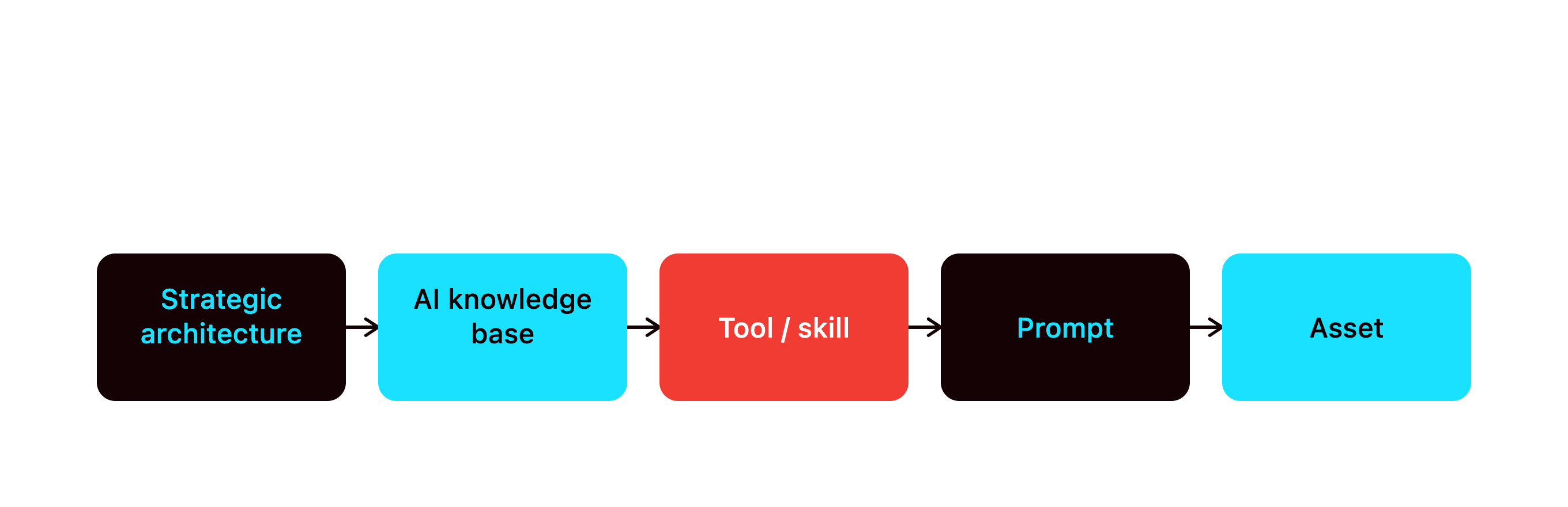
Everything after strategic architecture is now commodity. Every competitor buys the same models, the same optimization stack, the same production capacity. The only variable input left in the system is what you feed it. We build that input, in machine-readable form, so your team, your agencies, and your automation all work from the same definition of what makes you different.
- The Category Playbook - A codified single source of truth defining your proprietary space, your point of view, the core problem you solve, and the rules of the category you intend to own. One document that settles the arguments your team keeps relitigating.
- The Message Matrix - A structured taxonomy file your MarOps team uploads directly into your DAM and dynamic creative systems. It replaces improvised prompting with strict, pre-approved strategic parameters. Your asset engines stop guessing and start building from validated inputs.
Without strategic architecture, the organization starts to look like the REI bicycle. All of the components of a growth engine, but collectively, nothing makes sense. And no human can use it.
Subscribe to the blog.
More From the Blog
How Category Strategy Helps Clear the Traction Gap
If you’re in the Traction Gap, building more features won’t save you. What you need is a foothold. That emotional, intellectual, and strategic “purchase” that gets people leaning in before they sign on.
Read More →